TFK Programme Breaks Application Records and Delivers High-Quality Projects

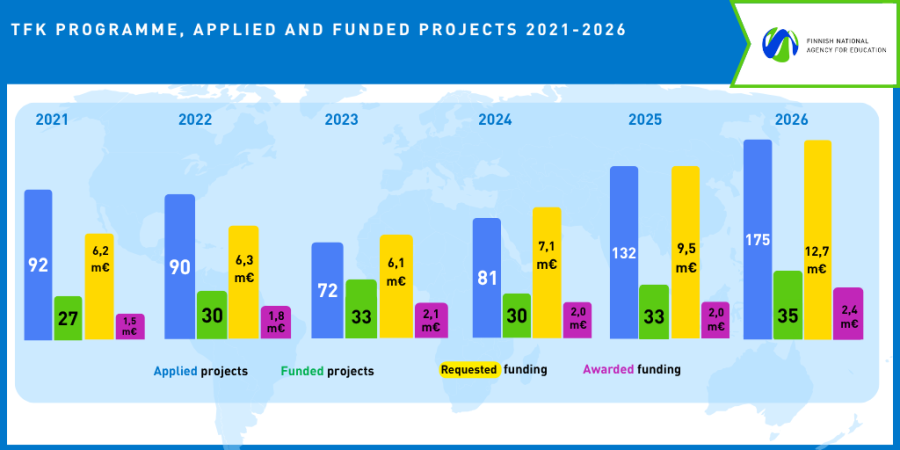
The 2026 TFK call closed on 27 April 2026. By the deadline, a total of 152 applications from 29 Finnish higher education institutions had been submitted to the main TFK call, while 23 applications from 19 institutions were submitted to the Ukraine call. In total, applicants sought €12.7 million in funding.
For the second consecutive year, the programme set new records for both the number of applications and the total amount of funding requested. Compared with the programme’s early years, application volumes have almost doubled.
Projects Funded in 2026 Address Sustainable Future Challenges and Train Future Digital Professionals
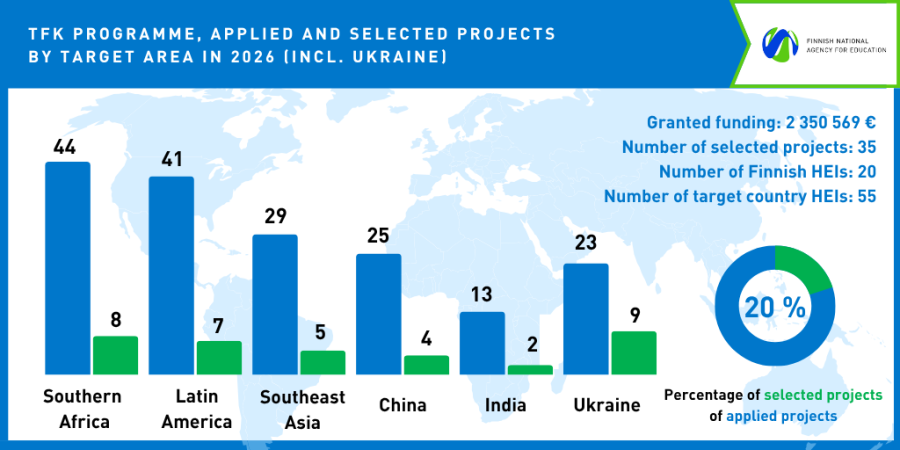
The Finnish National Agency for Education awarded a total of €2,350,569 to 35 projects. Of this amount, 26 projects funded under the main TFK call received €1,665,833, while nine projects funded under the Ukraine call received €684,737.
Funded projects represented 20% of all applications submitted. The primary selection criterion was the quality of the proposal. In addition, the selection process took into account the programme rule that no more than two projects from the same Finnish higher education institution can be funded for cooperation with a single target country or region. Funding was awarded to 9 projects in Ukraine, 8 in Southern Africa, 7 in Latin America, 5 in Southeast Asia, 4 in China, and 2 in India.
The majority of Finnish higher education institutions participate in the programme. A total of 33 Finnish higher education institutions took part in the 2026 applications either as project coordinators or partners, including 13 universities and 20 universities of applied sciences. The funded projects involve 11 Finnish universities, 9 universities of applied sciences, and 55 partner institutions in the target countries and regions.
The selected projects cover a wide range of disciplines, including engineering, teacher education, education sciences, social and behavioural sciences, environmental protection, and health sciences. The largest number of projects focus on engineering and engineering trades.
The projects address themes such as climate change adaptation, education for sustainability and cybersecurity, and the development of green and ethical digital solutions. They also explore indigenous knowledge systems and rights, decolonial perspectives, and sustainable futures through artistic approaches. Several projects develop innovative pedagogical cooperation models, including VR-based teaching and hybrid courses. Collaboration is guided by mutual learning, intercultural understanding, and responsible partnerships between participating higher education institutions.
Projects funded through the Ukraine call similarly focus on engineering, social sciences, business and administration, environmental protection, and teacher education. Selected projects aim to develop curricula in fields such as civil engineering, food technology, and business studies, while also establishing a teacher education programme to help address Ukraine’s need for qualified teachers. Strengthening expertise related to crisis preparedness and trauma-informed approaches is another important objective.
Most projects combine several forms of cooperation. Student and staff mobility between Finland and partner countries or regions, joint course and module development, and virtual teaching are among the most common activities. Although the ongoing war in Ukraine presents challenges for cooperation between higher education institutions, the selected projects nevertheless include a wide range of collaborative activities.
TFK Projects Deliver Strong Results
Results from completed TFK projects funded in 2021, 2022, and 2023 demonstrate that programme-funded projects are implemented effectively and generate strong outcomes in both mobility and international cooperation.
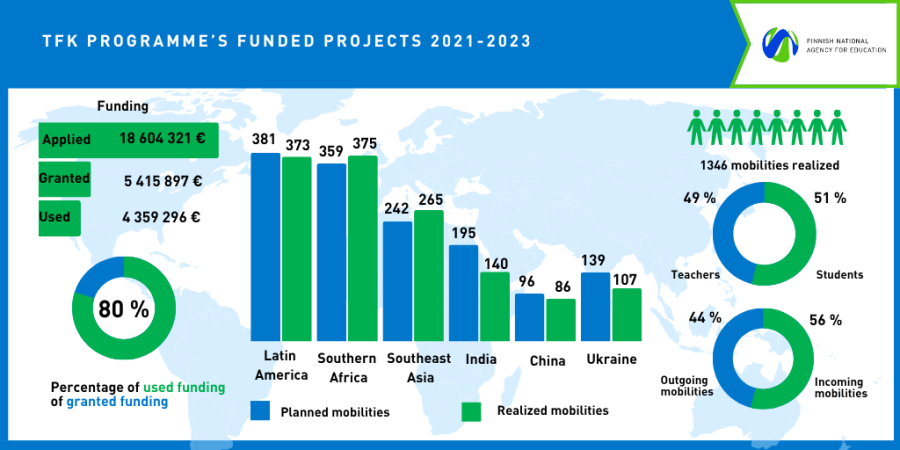
While projects funded in 2021 were still affected by the COVID-19 pandemic, approximately 90% of the funding awarded to projects funded through the main TFK call in 2022 and 2023 was ultimately used. Planned mobility activities were implemented at an average rate of 96%, highlighting the projects’ strong implementation capacity and their ability to sustain international cooperation even in changing operating environments.
Mobility participation was balanced across stakeholder groups. In completed projects, 51% of mobility periods involved students and 49% involved staff. Incoming mobility accounted for 56% of all mobility periods, while outgoing mobility represented 44%. This strengthened the international attractiveness of Finnish higher education institutions and supported the exchange of expertise in both directions.
Overall, the results indicate that the TFK Programme successfully supports extensive and diverse international cooperation around the world while creating meaningful opportunities for the professional and academic development of both students and staff.
To assess the programme’s broader impact, the Finnish National Agency for Education is currently conducting an evaluation of Team Finland Knowledge (TFK) cooperation projects funded between 2021 and 2023. The study examines project outcomes, long-term impacts, the programme’s operating model, and future development needs. The results will be published in a report in October 2026.
The next call for applications is expected to open in early 2027. Information on the target regions will be published later.